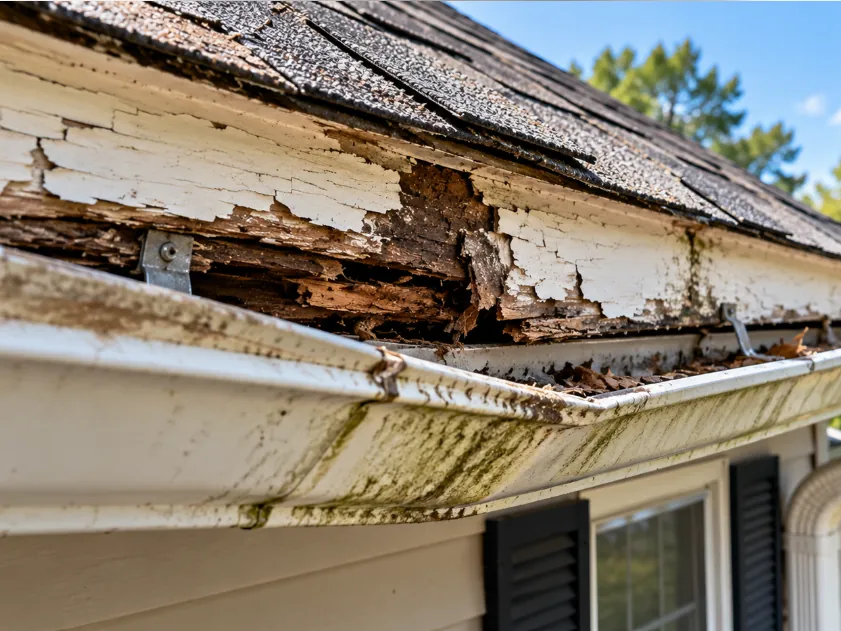
What is fascia board replacement?
Fascia board replacement removes damaged boards along the roof edge and installs new ones, along with any repairs needed to the rafter tails, decking edge and drip edge behind them. The fascia is the long vertical trim you see just below the edge of the shingles, usually with gutters attached to it.
Fascia does more than finish the look of the house. It ties the ends of the rafters together, gives gutters something solid to hang on and closes the roof edge against weather and animals. Behind it, the edge of the roof decking and the drip edge depend on the fascia staying sound. When the boards absorb water for long enough, the rot spreads into the rafter tails and decking edge, gutters pull away and overflow, and the problem accelerates. Replacing fascia early keeps it a trim job; waiting can turn it into a roof-edge rebuild. Because the drip edge above the fascia is part of the flashing system, our guide to roof flashing repair is useful background.
How is fascia replaced?
The job typically starts by removing the gutters, then prying off the damaged fascia boards. With the boards off, the roofer can see the rafter tails, the underside of the decking edge and the soffit framing. Any soft or rotted rafter ends are cut back and reinforced with sister boards. Damaged decking at the edge is replaced, which often means lifting the first course of shingles.
New fascia is cut to fit, primed or sealed on all sides if it is wood, and nailed to each rafter tail with corrosion-resistant fasteners. Joints between boards are made over rafters and cut at an angle so they shed water. The drip edge is checked and replaced if it is bent, rusted or missing, because it is what keeps water from running behind the gutter onto the new board. Finally, the gutters are reinstalled with correct slope toward downspouts, and gaps at soffit joints are sealed. Some homeowners choose to wrap new wood fascia with aluminum or use PVC boards for lower maintenance in Houston's humid climate.
8 signs your fascia boards need replacing
- Peeling or bubbling paintMoisture behind the paint is pushing it off the wood.
- Soft woodA screwdriver sinks into the board with little pressure.
- Dark stains or moldDiscoloration shows boards staying wet.
- Sagging guttersHangers lose their grip in rotting wood.
- Gaps at the roof edgeOpenings between fascia and roof or soffit.
- Insects or animalsBees, wasps, birds or squirrels entering at the edge.
- Water stains on the soffitOverflow running behind the gutter shows below.
- Cracked or split boardsOld wood splits as it repeatedly swells and dries.
What causes fascia to rot?
Gutter overflow is the most common cause. When gutters clog with leaves or pine needles, water spills over the back edge and soaks the fascia every time it rains. Gutters pitched incorrectly or hung too low can do the same. A missing or short drip edge lets roof runoff curl back under the shingles and run down the face of the board.
Houston's humidity adds to the problem because wood stays damp longer, encouraging rot and mold. Unpainted or poorly primed edges, especially the backs and ends of boards, absorb water quickly. Roof leaks near the eaves, such as water backing up under the first course during heavy downpours or worn shingles at the eaves, also wet the fascia from behind. Over time, insects and animals exploit softened wood and make the openings larger. Leaks at the roof edge can look like fascia rot, and our roof leak repair guide explains how roofers tell them apart.
Soffits often fail alongside fascia. The vented panels under the roof overhang let fresh air into the attic, and when fascia rots, the soffit edge it supports can sag, crack or fall away. Blocked or damaged soffit vents cut off the intake air that a ridge vent depends on, raising attic temperatures and moisture. Replacing fascia is a good time to clear insulation away from soffit vents and replace any damaged panels so the attic can breathe properly.
Fascia and soffit repair: what is the difference?
Fascia and soffit are repaired together so often that most people search for them as one job. The fascia is the vertical board along the roof edge that holds the gutters. The soffit is the horizontal panel underneath the overhang, often vented so air can enter the attic.
- Fascia repair Small, surface-level damage can sometimes be cut out and patched with a new section. Boards that are soft or crumbling are replaced, along with any rotted rafter tails behind them.
- Soffit repair Sagging, cracked or water-stained soffit panels are replaced, and the framing that holds them is checked. Vented soffit panels are kept clear so the attic can breathe.
- Pest damage Gaps in rotted fascia and soffit let birds, squirrels and insects into the attic. Replacing the damaged boards closes those openings.
Because fascia rot usually starts with water, fixing the cause matters as much as the boards. Gutters are re-pitched, drip edge is checked or replaced, and roof leaks at the eaves are fixed. If water is reaching the roof edge from a failed flashing joint, see our roof flashing repair guide.
What can you check from the ground?
Walk around the house and look along the roof edge for peeling paint, dark patches and boards that look swollen or uneven. Watch the gutters during a heavy rain to see whether water spills over the back. Check the soffit underneath for water stains, sagging or gaps.
From a stable ladder on firm ground, with someone holding it, you can press the board gently with a screwdriver in a few places along the lowest edge. Soft spots mean rot. Note any insect activity or nests near the edge.
Do not lean a ladder against a sagging gutter or rotted fascia. The board may give way. Stand the ladder against solid wall instead and never reach out to the side.
What happens during fascia replacement?
- Edge inspection. The roofer checks all fascia, soffits, drip edge and gutters around the house.
- Scope and material choice. You agree on which boards to replace and with what material.
- Remove gutters and boards. Gutters come down and damaged fascia is removed.
- Repair what is behind. Rotted rafter tails and decking edges are fixed.
- Install new fascia and drip edge. Boards are sealed, fastened and finished.
- Rehang gutters and clean up. Gutters go back up with proper slope and the site is cleared.
Which fascia material holds up best in Houston?
Primed wood is the traditional choice and easy to match on older homes, but it needs paint on every face and periodic repainting to resist rot in humid weather. Fiber cement resists rot and insects and holds paint well, though it is heavier to handle. PVC and composite boards do not rot and need little maintenance, which makes them popular in shaded, damp locations. Aluminum wrap over wood creates a low-maintenance finish, but water that gets behind the wrap can rot the board unseen.
Whatever the material, the details matter more. Boards should be sealed on all sides and ends before installation, joints should fall over rafters, fasteners should resist corrosion and the drip edge should overhang into the gutter. Older homes in neighborhoods like Houston Heights sometimes have decorative trim profiles, so ask the roofer whether they can match the original look while upgrading the material behind it.
What affects the cost of fascia board replacement?
Fascia jobs are priced mainly by length and by what is found behind the boards.
| Factor | How it affects price |
|---|---|
| Linear feet replaced | A single board costs less than the full perimeter. |
| Material | PVC, fiber cement and wrapped fascia cost more than primed wood. |
| Rafter tail damage | Sistering or replacing rafter ends adds labor. |
| Gutter work | Removing, rehanging or replacing gutters affects the total. |
| Height and access | Second-story edges need taller ladders or scaffolding. |
When is fascia damage urgent?
It becomes urgent when a gutter is pulling away and could fall, when large openings let animals into the attic, or when water is visibly running behind the gutter into the house. Rot that has reached the rafter ends also needs attention before the roof edge weakens further.
Clean gutters at least twice a year, and more often under pines or oaks. Keeping water flowing to the downspouts is the simplest way to protect new fascia.
Roof edges are often checked during a full roof inspection, and our homepage lists every service from roofing contractors in Houston.
Questions about fascia board replacement
Is fascia part of the roof or the gutters?
Fascia is part of the roof edge. It is attached to the rafter tails and supports the gutters. Because roof water and gutter overflow both affect it, roofers commonly handle fascia replacement.
What material is best for replacement fascia?
Options include primed wood, fiber cement, PVC and aluminum wrap over wood. PVC and fiber cement resist rot and insects better in humid climates, while wood is easy to match on older homes.
Can fascia be repaired instead of replaced?
Small surface damage can sometimes be filled and painted, but boards with soft or crumbling wood should be replaced, since the rot usually extends beyond what is visible.
What is the difference between fascia and soffit?
Fascia is the vertical board along the roof edge. The soffit is the horizontal underside of the overhang, often vented to let air into the attic.
Why are there bees or birds around my roof edge?
Gaps in rotted fascia or soffits give insects, birds, squirrels and other animals access to the attic. Replacing damaged boards closes those openings.
Do the gutters have to come down for fascia replacement?
Usually yes. Gutters are removed, the fascia is replaced, and the gutters are reinstalled or replaced, often with improved pitch and hangers.
Should fascia and soffit be repaired at the same time?
Usually, yes. Water that rots fascia often damages the soffit beneath it, and both are reached from the same ladder or scaffold, so repairing them together is more practical.